PollinERA and WildPosh joint presentation at ‘Pesticides and pollinators’ seminar
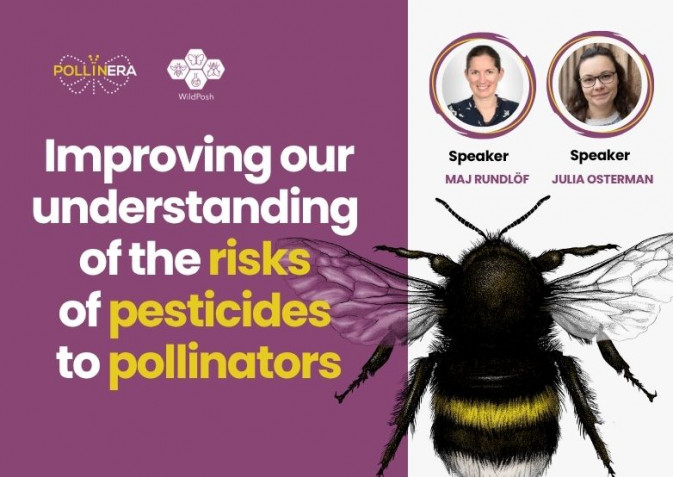
This month, the PollinERA project partner, Maj Rundlöf from Lund University, and the WildPosh project partner, Julia Osterman from the University of Gothenburg, took part in a seminar ‘Pesticides and pollinators’. The event was hosted by the FRAM - Centre at the University of Gothenburg and BECC, and explored how pesticides threaten pollinators, with bees as a key example, how exposure and sensitivity vary across species, and why these differences matter for assessing pesticide risks.
The two researchers gave a joint presentation on improving our understanding of the risks of pesticides to pollinators. Maj Rundlöf highlighted that wild bees are routinely exposed to complex mixtures of pesticides, yet EU risk assessments still rely largely on honeybees as representatives of all bee species. Drawing on field study, she showed that wild bees can be far more vulnerable to pesticide exposure than honeybees.
Building on this, Julia Osterman presented her work on the role of diet specialisation in wild bee susceptibility. Through the WildPosh project, she is developing standardised methods to study specialist and generalist solitary bees exposed to pesticides and pesticide mixtures, generating data needed to improve risk assessments for Europe's diverse wild bee species.
During the seminar, the current gaps in risk assessment frameworks were highlighted. Discussions also outlined potential improvements and mitigation strategies to better protect pollinators and the ecosystems that depend on them.
Maj Rundlöf, Docent, Biodiversity and Evolution, Lund University, from the PollinERA project
WildPosh partner Julia Osterman, PhD, Dept. of Biological and Environmental Sciences, University of Gothenburg
You can watch the full seminar here: